
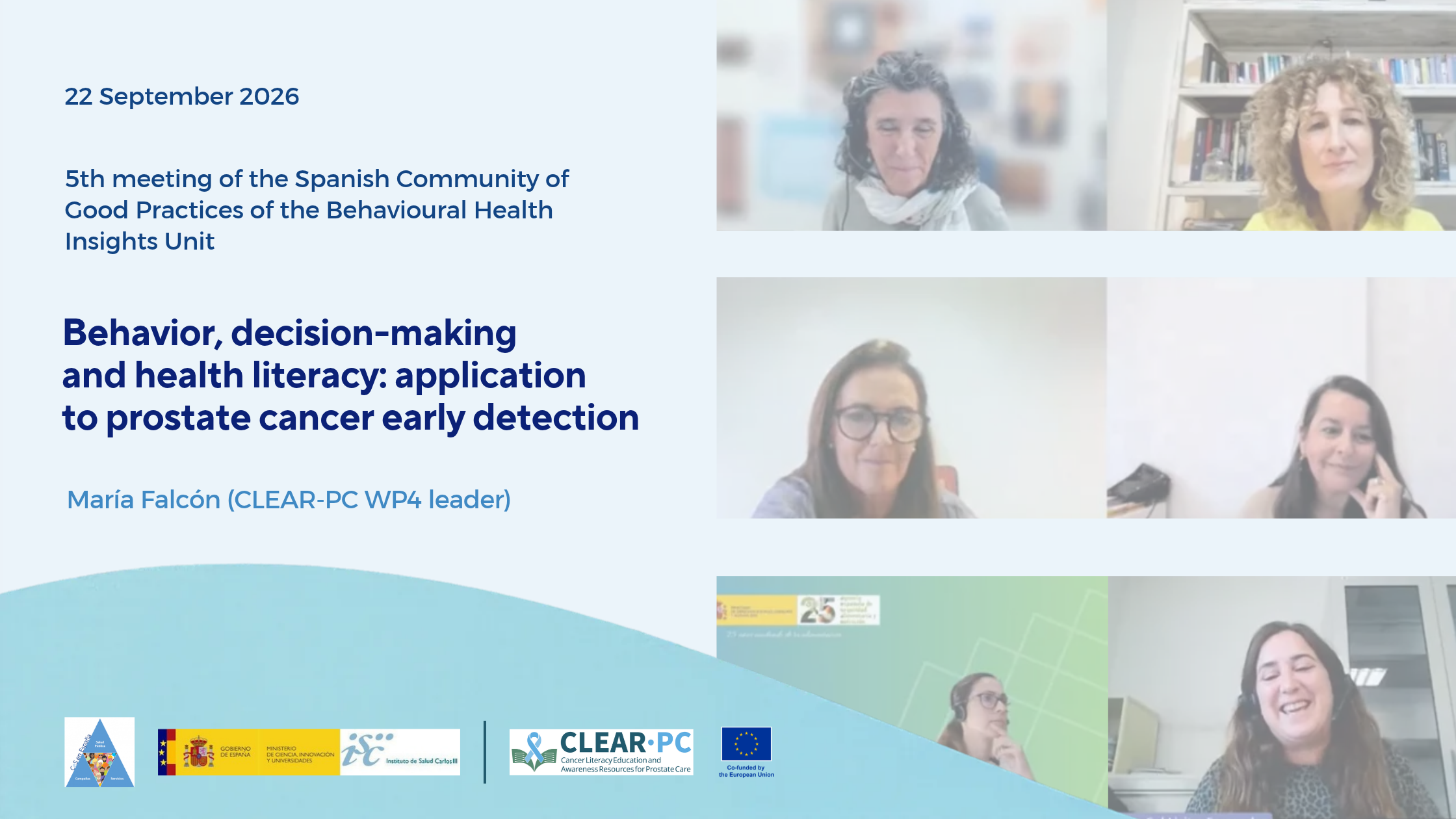
On 22 September 2026, the 5th meeting of the Spanish Community of Good Practices of the Behavioural Health Insights Unit at the Carlos III Health Institute, took place. The session, focusing on health literacy, featured a presentation by María Falcón, Professor at the University of Murcia and leader of Work Package 4 of the European CLEAR-PC project. Her presentation explored the role of behaviour and decision-making in prostate cancer screening.
Her contribution highlighted the importance of health literacy in prostate cancer-related decision-making and addressed the challenges people face in today’s society, particularly in the context of the growing influence of artificial intelligence, social media and new technologies on health-related information and decisions.
Given the complexity of information about prostate cancer, health literacy enables patients to understand and assess the available options and to participate in informed decision-making throughout their care pathway.
To gain a better understanding of health literacy levels regarding prostate cancer across Europe, the CLEAR-PC consortium has conducted a population-based survey among men aged 40 and over in 5 European countries. According to the preliminary findings, based on responses from nearly 3,000 participants, more than half of respondents have limited health literacy. Among the main difficulties reported by participants were applying the information they receive to improve their health and assessing the reliability of information from media.
Regarding shared decision-making, half of the men surveyed who visited a doctor in the past year reported that they had not been offered different treatment options. Furthermore, their personal preferences were rarely taken into account when decisions about the most appropriate treatment were made.
Understanding health literacy levels in the context of prostate cancer is one of the first steps towards identifying the barriers and needs people face when accessing, understanding and using health-related information. CLEAR-PC aims to translate scientific evidence into the design and development of tailored tools and resources for prostate cancer. These will seek to improve health literacy in relation to the disease and contribute to reducing health inequalities.
To watch the full presentation by María Falcón on health literacy and the CLEAR-PC project (in Spanish), you can access the video below and enable your preferred language using the video player’s automatic subtitles.
The Spanish Community of Good Practices of the Behavioural Health Insights Unit at the Carlos III Health Institute, which also serves as the WHO National Focal Point, provides a platform for sharing knowledge and experiences and strengthening collaboration in the fields of behavioural science and public health.