
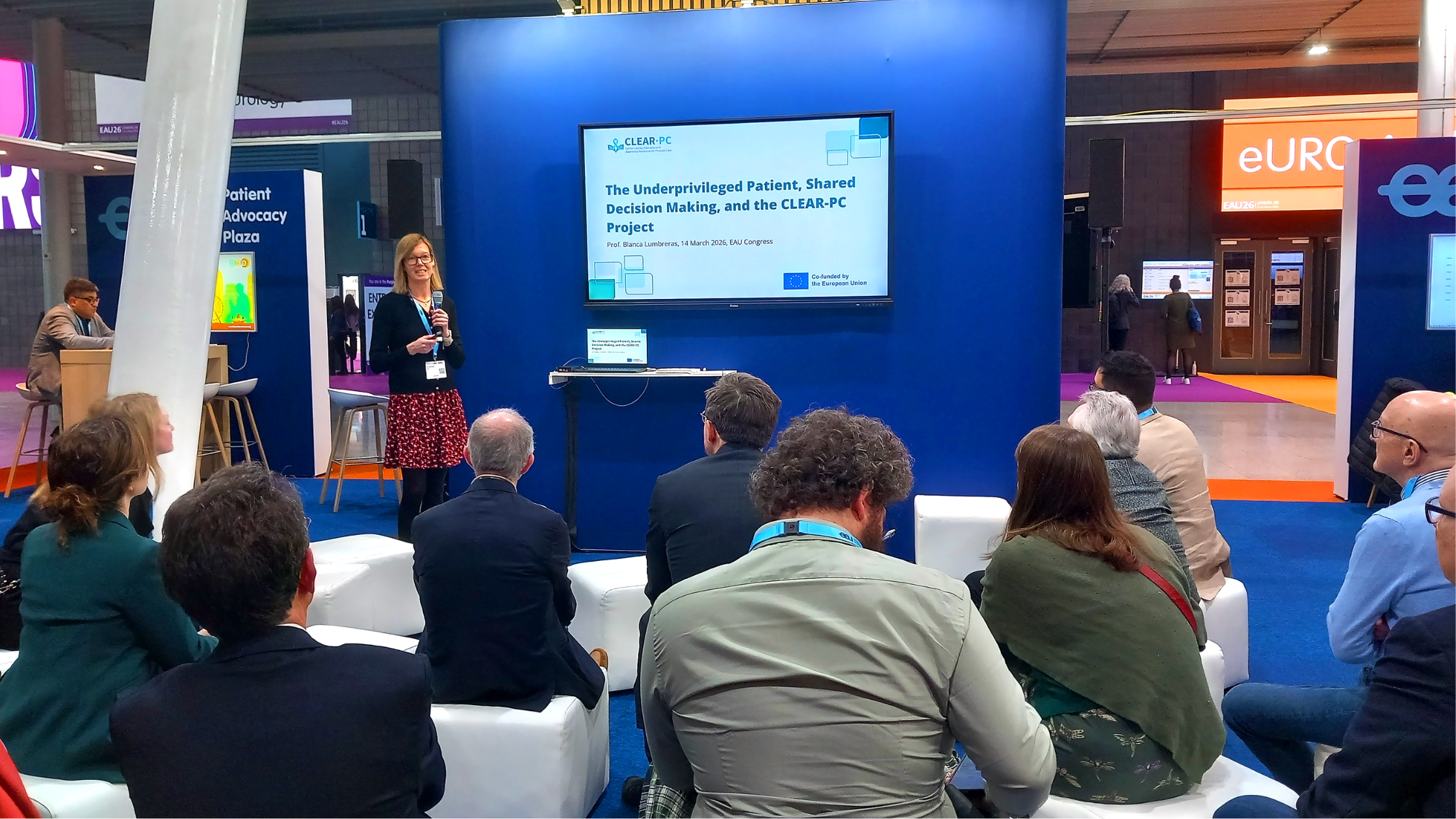
Blanca Lumbreras (Universidad Miguel Hernández) and Erik Briers (Europa Uomo) presented a special session entitled “The Underprivileged Patient, Shared Decision-Making, and the CLEAR-PC Project” during the European Association of Urology (EAU) Congress held in London on 14 March.
The session highlighted how underprivileged groups, including older adults, immigrants, refugees, marginalised communities, and people with limited financial resources, often face significant barriers to accessing, understanding, and using health information.
These challenges contribute to persistent inequalities across the prostate cancer care pathway, from screening and diagnosis to treatment and palliative care.
Health literacy and shared decision-making
“One of the main challenges in prostate cancer is ensuring that all patients can participate in decisions about their treatment and care”, Blanca explained.
Shared Decision-Making (SDM) is a collaborative process in which patients and healthcare professionals work together to make informed healthcare decisions. It combines the best available evidence with the patient’s values, preferences, and circumstances to support decisions that are both evidence-based and person-centred.
However, making collaborative choices is particularly difficult for underprivileged patients, who often lack clear, accessible information to be able to participate effectively in the decision process.
“People in vulnerable situations, such as those with lower levels of health literacy, language barriers, or limited access to digital information, often find it much more difficult to understand their options and navigate the healthcare system.”
Strengthening health literacy related to prostate cancer care
The CLEAR-PC project aims to tackle the challenge. “Through the CLEAR-PC project, we are working to reduce these inequalities by developing tools and strategies to improve health literacy”, Blanca explained.
The consortium is working closely with key stakeholders, including vulnerable populations across Europe, to co-create these resources. They will range from practical decision aids and educational videos to training materials for healthcare professionals and public awareness campaigns.
Through these resources, CLEAR-PC aims to empower all prostate cancer patients to find, understand, and evaluate health information, participate more actively in decisions about their care, and ultimately contribute to more equitable prostate cancer care for vulnerable populations across Europe.